Almost every op-amp circuit you will ever analyse by hand comes from two assumptions. Learn these and you can skip the algebra most of the time.
- No current flows into the inputs. Input impedance is infinite.
- The op-amp drives its output until the two inputs are at the same voltage. This is the virtual short, and it only holds when there is negative feedback.
Assumption 2 has a precondition
The virtual short is a consequence of feedback, not a property of the part. Wire the feedback to the non-inverting input and the op-amp slams to a rail instead — which is exactly how you build a comparator or a Schmitt trigger.
Inverting amplifier
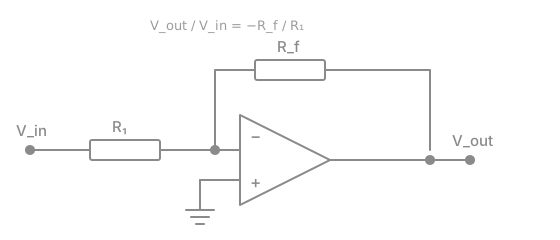
With the non-inverting input grounded, assumption 2 pins the inverting node at 0 V. All of therefore has to flow through , giving
The minus sign is the whole trick: the input sees a resistor to a virtual ground, so input impedance is just , not the op-amp’s.
Non-inverting amplifier
Feed the signal straight into the + input and divide the output back into
-:
Input impedance is now the op-amp’s own, which is enormous. That is why the unity-gain buffer (, ) is the default way to stop a high-impedance source from being loaded.
The assumption that breaks first
Gain is not infinite at frequency. Real parts have a roughly constant gain–bandwidth product:
A 1 MHz GBW part configured for a gain of 100 is flat to 10 kHz and no further. This is the number that quietly ruins audio designs, and it is why the Sallen-Key note insists on checking GBW against the filter’s corner frequency before you trust the response.
See also
- Sallen-Key Low-Pass Filter — two of these plus four passives
- Back to the vault